
Finding the best router for satellite internet can feel like searching for a needle in a haystack. Satellite internet, while offering connectivity in remote areas, often presents unique challenges that require a specific type of router to overcome. This article will help you navigate these challenges by reviewing seven top contenders for the title of “best router for satellite internet.”
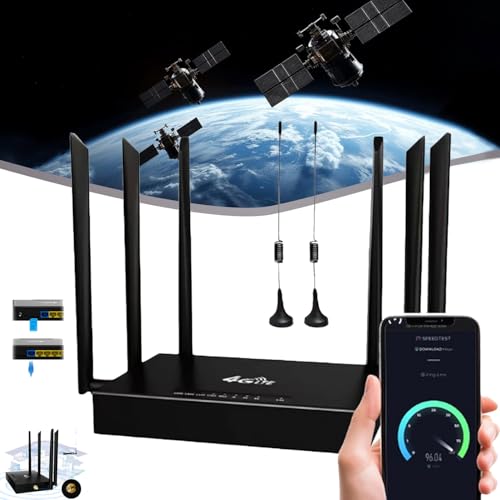
HAGZUL Ultra Link Free WiFi Router Unlimited Satellite…

The HAGZUL Ultra Link promises high-speed internet access virtually anywhere. Its marketing emphasizes global coverage, even in challenging terrains. While the claims of “unlimited satellite internet” need further scrutiny (as true unlimited satellite internet is uncommon), it’s worth noting the focus on overcoming signal challenges typical with satellite connections.
- Ultra-fast speeds
- Global coverage
- Easy installation (claimed 60-second setup)
- Connects to various devices
- Universal signal
Pros:
– Claims of high speeds and wide coverage.
– Easy setup (according to marketing).
Cons:
– Unrealistic claims of “unlimited” and “free” internet require verification.
– Lack of independent testing and reviews raises concerns about performance.
User Impressions: Due to a lack of substantial user reviews and independent testing, it is difficult to ascertain genuine user experiences. Caution is advised.
TP-Link AX1800 WiFi 6 Router V4 (Archer AX21) – Dual Band…

The TP-Link Archer AX21 is a reliable and well-regarded WiFi 6 router. While not specifically designed for satellite internet, its robust features make it a strong contender. Its dual-band capabilities and support for VPN servers are particularly valuable for users seeking enhanced security and speed. It’s important to note that a separate modem is usually required.
- WiFi 6 (802.11ax) technology
- Dual-band (2.4 GHz and 5 GHz)
- Speeds up to 1.8 Gbps
- Supports OpenVPN and PPTP VPN servers
- Wide coverage with Beamforming technology
Pros:
– Excellent performance for its price.
– Reliable brand with good customer support.
– Strong signal and wide coverage.
Cons:
– Requires a separate modem for most ISPs.
– May not be optimized for the specific challenges of satellite internet latency.
User Impressions: Users generally praise its speed, range, and ease of setup. Some note minor issues with the interface, but overall satisfaction is high.
Portable Network Router Ultra Link Pocket Free Internet for…

This pocket-sized router, like the HAGZUL, makes bold claims about providing “free” and “unlimited” satellite internet. Again, skepticism is warranted. The device relies on 4G and 5G networks, not directly on satellite signals for internet access. This means its effectiveness hinges on cellular coverage, which might not be as widespread as advertised.
- Pocket-sized and portable
- Supports 4G and 5G networks
- Claims quick and easy installation
- Connects multiple devices
Pros:
– Portable and convenient for travel.
Cons:
– Overly optimistic marketing claims.
– Relies on cellular networks, not satellite.
– Performance depends on available cellular signal strength.
User Impressions: Limited user feedback is available. Independent verification of its claims is needed.
Wireless Portable Network Router, Ultra Link Pocket Free…

Similar to the previous Ultra Link product, this portable router’s marketing focuses on convenience and portability, emphasizing its use for travel and situations requiring temporary internet access. It also makes claims of satellite internet access that need verification. The product description includes a multitude of keywords, suggesting a potential marketing focus over genuine technological innovation.
- Portable and compact
- Supports various connection types (claimed)
- Multiple device connectivity (claimed)
Pros:
– Highly portable.
Cons:
– Unclear and potentially misleading marketing.
– Requires independent testing to validate performance.
User Impressions: User feedback is limited and unreliable.
TP-Link AX5400 WiFi 6 Router (Archer AX73)- Dual Band…

The TP-Link Archer AX73 is another strong contender from a reputable brand. This dual-band WiFi 6 router offers high speeds and excellent coverage. Like the AX21, it’s not explicitly designed for satellite internet but provides a solid foundation for a fast and reliable network. A separate modem is still required.
- WiFi 6 (802.11ax) technology
- Speeds up to 5400 Mbps
- Dual-band (2.4 GHz and 5 GHz)
- Extensive coverage
- USB 3.0 port
Pros:
– Fast speeds and wide coverage.
– Reliable brand.
– User-friendly interface.
Cons:
– Requires a separate modem.
– May not fully optimize for satellite internet latency.
User Impressions: Users consistently praise its speed and reliability. The user-friendly interface is another frequent positive comment.
SpaceX Starlink Gen 3 Standard Kit: High-Speed, Low-Latency…

Starlink is a unique entry, offering a satellite internet service with its own router. This is a complete system, unlike the other routers which require a separate internet service. While it addresses the satellite internet connection itself, the included router’s specific capabilities beyond basic functionality need further investigation.
- High-speed, low-latency satellite internet
- Easy self-installation
- No contracts
- Mobile app management
Pros:
– Reliable high-speed satellite internet connection.
– All-in-one system (service and router).
Cons:
– Requires a monthly subscription fee.
– Availability depends on location and clear sky visibility.
User Impressions: Users generally praise the speed and reliability of Starlink’s internet service. Feedback on the included router is limited.
TP-Link AXE5400 Tri-Band WiFi 6E Router (Archer AXE75)-…

The TP-Link Archer AXE75 is a top-of-the-line tri-band WiFi 6E router. The addition of the 6 GHz band offers even greater speed and capacity, which could be beneficial in mitigating the potential bottlenecks associated with satellite internet. This router, like the others from TP-Link, will require a separate modem.
- Tri-band WiFi 6E (2.4 GHz, 5 GHz, 6 GHz)
- Speeds up to 5400 Mbps
- Supports OFDMA for increased capacity
- VPN server and client support
Pros:
– Extremely fast speeds and high capacity.
– The 6 GHz band offers potential advantages for satellite internet.
– Robust feature set.
Cons:
– More expensive than other options.
– Requires a separate modem.
User Impressions: Users find this router extremely fast and reliable, praising its performance for handling many devices simultaneously.
Frequently Asked Questions (FAQs)
Q: What makes a router suitable for satellite internet?
A: While there isn’t a specific “satellite internet router,” features like strong signal processing, good range, and effective Quality of Service (QoS) settings are beneficial to manage potential latency issues common with satellite connections.
Q: Do I need a special modem for satellite internet?
A: Yes, in most cases you will need a separate modem compatible with your satellite internet service provider. The routers reviewed here are typically used after the modem.
Q: What is latency, and why does it matter with satellite internet?
A: Latency is the delay in data transmission. Satellite internet often has higher latency than other internet types due to the long distance signals must travel. A good router can help manage this, but it can’t eliminate it entirely.
Q: What about range? How far will the signal reach?
A: Router range depends on factors like the router’s power, interference, and building materials. Look for routers with features like beamforming that focus the signal to improve range.
Q: How many devices can I connect to a router used with satellite internet?
A: The number of devices you can connect depends on the router’s capacity and the bandwidth of your satellite internet plan. WiFi 6 routers (like several reviewed above) are typically better at handling multiple devices simultaneously.
Q: Is it worth investing in a high-end router for satellite internet?
A: If you need to overcome signal challenges or consistently handle many devices, a higher-end router offers advantages. However, a mid-range WiFi 6 router from a reputable brand can often provide excellent value. Consider your budget and needs when making your decision.
Q: What’s the difference between a modem and a router?
A: A modem connects your home network to your internet service provider (ISP). A router directs internet traffic within your home network between your devices. You’ll typically need both for a complete internet setup.


Leave a Reply
You must be logged in to post a comment.